feelings

progress report

there are zillions of pieces of advice out there on how to write, but the most logical ones boil down to two points.

(1) put your butt in the chair and write.
(2) in order to get better at writing, you have to WRITE.

sure, reading and living a full life are also keys to becoming a better writer (and a better human), but the practicality of practicing writing is too true to ignore, as @fakeeditor (#2) so helpfully explains.

i thought i’d been doing that. i have one completed manuscript under my belt not to mention an MFA degree, and yet, i kept coming up with doubt about the state of my current (finished but unedited) WIP. i wondered why my writing wasn’t getting better. i thought taking some time away from it would help. i thought diving in and doing more research would help. i thought reading it over and over would help. i thought doing some character interviews would help.

it didn’t.

in a fit of distraction, i started to peruse my old blog postings because i couldn’t remember when i had changed from diaryland.com to wordpress.com. that switch, from casual musings to carefully thought out postings, marked the beginning of my attempts to become a writer and i was curious what that actual date was. (7.21.09 for inquiring minds.)  it took longer than i anticipated to find the beginning  and i couldn’t help but read a bunch of the posts as i scrolled my way through. after reading through some highly embarrassing and super revealing and poorly crafted posts, i realized something.

i HAVE made progress. it’s just not the progress i was expecting.

the progress i’ve made has been in the form of emails and blogs because that’s what i’ve been doing daily for years now. sure, it may have been a thing necessitated through work or a premature attempt at building a brand, but it’s been the most consistent form of writing that i’ve been practicing and THAT’S why those types of words come more easily to me.

now hold up, i’m not saying when i open an email or fresh post, the right words march out and lay down in the proper formation, but it’s much easier to twist those words into the desired shape whereas the words in my novel look a bit more like this:

so the point of this was not to direct you to my most remedial writings, but as a note to myself to lighten up in the areas of my manuscripts because i’m still new to the game and my talent still needs time to be cultivated.

now, how to work on being more patient?

how do YOU work at getting better at what you do — whether it’s a hobby, a job, or a career?


wordpress com stats plugin
writing

guest post: grandpa, round 2

my dad’s dad keeps the wisdom coming and it’d be a crime to keep it from you.

you’re welcome.

Words are things; and a small drop of ink / Falling like dew upon a thought, produces / That which makes thousands, perhaps millions, think. Lord Byron, (1788-1824)

It is my belief that the writer, the free-lance author, should be and must be a critic of the society in which he lives. It is easy enough, and always profitable, to rail away at national enemies beyond the sea, at foreign powers beyond our borders who question the prevailing order. But the moral duty of the free writer is to begin his work at home; to be a critic of his own community, his own country, his own culture. If the writer is unwilling to fill this part, then the writer should abandon pretense and find another line of work: become a shoe repairman, a brain surgeon, a janitor, a cowboy, a nuclear physicist, a bus driver.
Edward Abbey, naturalist and author (1927-1989)

My stories run up and bite me in the leg — I respond by writing them down — everything that goes on during the bite. When I finish, the idea lets go and runs off.
Ray Bradbury, science-fiction writer (b. 1920)

A writer needs three things, experience, observation, and imagination, any two of which, at times any one of which, can supply the lack of the others.
William Faulkner, novelist (1897-1962)

A word is not the same with one writer as with another. One tears it from his guts. The other pulls it out of his overcoat pocket.
Charles Peguy, poet and essayist (1873-1914)

Most people think that shadows follow, precede, or surround beings or objects. The truth is that they also surround words, ideas, desires, deeds, impulses and memories.
Elie Wiesel, writer, Nobel laureate (b. 1928)

Language is not an abstract construction of the learned, or of dictionary makers, but is something arising out of the work, needs, ties, joys, affections, tastes, of long generations of humanity, and has its bases broad and low, close to the ground.
Noah Webster, lexicographer (1758-1843)

This passage is a quotation from Henri Nouwen‘s book “Reflections on Theological Education”:

“Somehow I believed that writing was one way to let something of lasting value emerge from my little, quickly passing life….. Most students think writing means writing down ideas, insights, visions. They feel that they must first have something to say before they can put it down on paper. For them writing is little more than recording pre-existent thought. But with this approach true writing is impossible. Writing is a process in which we discover what lives in us. The writing itself reveals what is alive…. The deepest satisfaction is precisely that it opens up new spaces within us of which we were not aware before we started to write. To write is to embark on a journey whose final destination we do not know.”

In order that people may be happy in their work, these three things are needed: they must be fit for it; they must not do too much of it; and they must have a sense of success in it.
John Ruskin, author, art critic, and social reformer (1819-1900)

i’m so grateful i have a grandfather whose research skills and internet know how are top notch (because mine aren’t) because i’m certain i never would have found these without his help. even though these authors’ works are unfamiliar  to me, their words above all seem familiar in their sentiment, which in turn, makes ME feel like a writer and not so much a “writer.” thank you for that, grandpa! and thank you charles peguy for saying what you said.


wordpress com stats plugin
feelings

newton’s third law

i happened to be in the kitchen when my mom was reading about the cookies. hearing when she laughed (and when she didn’t) was illuminating. i was sort of disappointed when she failed to laugh at my favorite pic (the one of bro-in-law T’s cookie) until i asked her why and she informed me she had skipped right over it. it wasn’t because she didn’t like it, but rather because she’s still learning how to work her new iPhone.

watching a reader’s reaction while they’re reading my writing was new to me. people have commented to me post-read and i LOVE that, but it’s not quite the same as witnessing it firsthand. probably because the latter is more raw. the reader doesn’t have time to form a politically correct opinion or decide which words will soothe my writer’s ego. i am thankful for the chance not to have smoke blown up my arse even if the reaction wasn’t 100% what i wanted.

it means i have to work harder.

and then, later, i came across a reaction i wasn’t expecting, nor do i think i was supposed to see. i picked up sister E’s phone (to try out Siri) and was blown away when i saw her background picture. it was of a page from THE SCORPIO RACES, which is one of my favorite books from 2011. she had read it over the christmas break (because i gave it to her) and i gathered that she wasn’t in love with it like i was. that’s fine and dandy and that’s why there are a jillion books out there in the world, each for a separate kind of reader.

but i can’t help but think that she tried just a bit harder to like it because i did. that she took a picture of the page in an effort to find out what made it so irresistible to me. maybe it’s egotistical of me to think that. maybe she really did love it like i did. but maybe she just loves me, and that’s some kind of wonderful.


wordpress com stats plugin
writing

sacrifices

i was going about things all wrong.

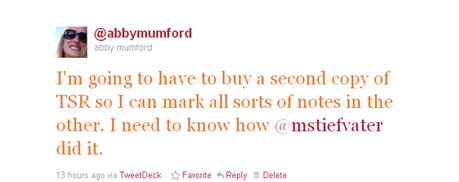
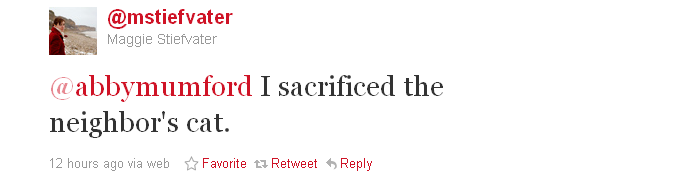
first, i had twitter open. second, i had been listening to THE SCORPIO RACES by maggie stiefvater. third, i also had the book open on my desk as i perused it trying to turn it into a textbook because i can’t stop thinking about it and i’m basically in love with it and all that it does.

you might say i’m slightly obsessed.

this wasn’t the problem.

the problem was that by studying/reading/looking at another book, my focus had shifted away from my own work. even though i had the best of intentions when opening THE SCORPIO RACES (i.e. wanting to learn), it’s way too easy to compare my writing to the masterfulness of that novel and clearly, that’s not fair.

and then the downward spiral of self-doubt began, which is NOT the brain space you want to be in when revising your work.

but before i closed THE SCORPIO RACES, i, of course, turned to twitter to voice my opinion BECAUSE EVERYBODY NEEDS TO READ THIS BOOK.

with the mystery of publishing revealed, i closed THE SCORPIO RACES and twitter. i read sean ferrell’s “pathetic email” post for the tenth time because it’s uplifting and spot on and exactly the right motivation i needed to dive back into my edits because it’s time to whip this WIP into shape.

now if only my neighbor had a cat…

writing

FWIS: growing your story

remember this post? remember these two ladies? jessica corra and bria quinlan? good, because it’s time for another round.

today’s topic: growing your story.

in keeping with the theme from last month, i happen to be at the beginning of this stage as well. i finished my disaster draft on november 10 and then i didn’t look at it again until december 1, three weeks later. i was attempting to get some space from the story and the characters before i dove in to do the revisions.

oh, but first, a little tidbit about me. i am an under writer. no, not this kind but rather, someone who (on the first draft) writes less rather than more. my first draft clocked in at 44K and a typical YA novel runs anywhere from 60K-80K words, so you can see i have a lot of growing to do.

the things i’ve done to grow (other than drink lots of milk and eat vegetables) are character interviews, chapter mapping and world building. also, taking notes and making suggestions and fixing dialogue and printing out my story and handwriting revisions and moving scenes around and deleting portions and adding phrases and puffing up passages and phew!

growing is hard.

but audiences are perceptive and precocious and practically perfect and so i don’t want to disappoint any of them even if, at this juncture, they’re only imaginary.

so, onward and forward and backward and sideways and every which way the story demands because i want smooth transitions and moments that make you weep and uncontainable giggles and characters so real, you have to pat the couch to make sure they’re not sitting next to you.

make sure to check out bria’s and jessica’s posts to see what types of growing they’re doing.